
Inside San Rafael's Directory Collections
Marin's documented directory shelf spans regional volumes, dedicated San Rafael books, social directories, telephone books, and later subscription scans. Coverage is not continuous. A year in one catalog may be held in the Anne T. Kent California Room, while another year appears through in-library databases or a historical research collection. The table keeps the main runs distinct.
| Collection | Years | Where Held | Access |
|---|---|---|---|
| McKenney district directories | 1878-79, 1884-85, 1885-86 | Kent California Room | Locked/reference holdings |
| San Rafael and Marin Directory | 1887-88 | Kent California Room | 1887 locked case call number |
| Kingsbury city and county directory | 1905-06 | Local research collections | Reference use |
| Independent's Marin County Directory | 1925 | Historical collections | Reference or database |
| A to Z Marin County Directory | 1939-40, 1946-47, 1949-50, 1952-53, 1954-55 | Library/local history | Collection access varies |
| San Rafael city directory scans | 1905, 1911, 1925, 1953, 1955, 1960, 1962, 1963, 1965, 1966, 1968 | Ancestry Library Edition | In-library access |
| Blue Books and telephone books | 1889, 1895, 1899, 1921-22, 1925; examples 1933 and 1940 | Genealogy and historical collections | Not comprehensive |
The gaps matter. These are documented years, not a promise that every annual San Rafael city directory survives or is open online. The exact reverse-directory run should be confirmed with the Kent Room before a research trip.
Note: A listed year proves a cataloged holding, not that every volume is digitized, complete, or available without staff help.
San Rafael Directory Publishers
McKenney's regional directories are the earliest named run in the local guide. Marin entries can include a resident, occupation, and sometimes acreage, which makes an early county book different from a later telephone listing. The 1887-88 San Rafael and Marin Directory was issued by American Directory Publishing Company and printed by Bacon and Company. Kingsbury followed with a 1905-06 city and county volume. R.L. Polk's 1925 Independent's Marin County Directory and A to Z's later runs add new time points.
A city directory can change its scope without changing its title. One publisher may list a head of household and occupation. Another may add a reverse street section or a social directory. Blue Books describe social membership and are not comprehensive resident rolls. Telephone directories may omit unlisted households and do not explain whether a person owned the address.
The publisher, title page, street guide, and abbreviation key are part of the evidence. Photograph or note those pages before reading a name entry.
San Rafael City Directory Shelves
The Anne T. Kent California Room in Room 427 at 3501 Civic Center Drive is the primary public local-history stop. It is open Monday through Friday from 9 a.m. to 6 p.m. and can be reached at 415-473-7419 or californiaroom@marincounty.gov. Staff says an appointment is not required, but off-site material may need 24 to 48 hours for retrieval. The Survey Map and Special Collections Annex opens Thursdays from 1 to 5 by arrangement.
The Kent California Room location page explains the room and retrieval practice. Its local-history guide lists census indexes, tax lists, cemetery volumes, directories, and the Flack's Marin Chronology index. The digital collection adds photographs, oral histories, and historic newspaper material. The Marin History Museum Research Library at 1125 B Street holds biographical files, yearbooks, telephone directories, maps, and a “Researching A Home in Marin County” guide. Its listed hours are Wednesday and Friday from 11 to 3 and by appointment.
When a city directory is absent, the library shelf can point to a newspaper, map, oral history, or home file that supplies the missing date.
The Marin Library history and genealogy route is shown in this captured view.
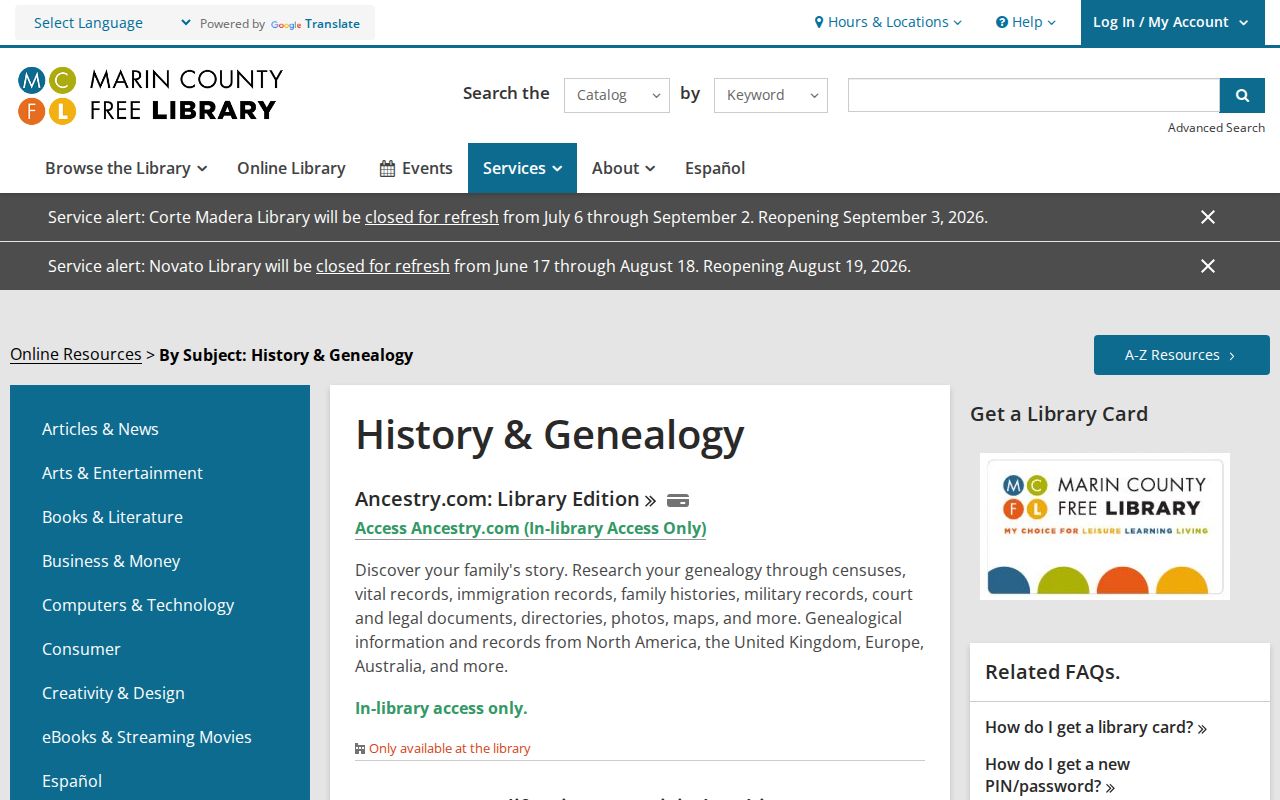
The page connects directories with censuses, newspapers, and local-history help, which is the right way to fill a missing directory year.
Note: The Kent Room's retrieval window is part of access planning, especially when a directory is held off site.
How to Read San Rafael Directory Entries
A typical San Rafael city directory entry begins with a surname, then a given name or initial. A spouse may appear in parentheses. The next clues can be occupation, business affiliation, home address, and a short mark such as “r,” “h,” or “wid.” Early county books sometimes add acreage. Later reverse pages may change the order to street, number, and occupant. Read the key for that volume before expanding an abbreviation.
Read the entry as a dated bundle of clues. A name-and-address pairing can guide a family-history search, while an owner mark or business affiliation needs confirmation in a deed, tax list, or another directory year.
| Name | Surname first, followed by given name or initial; spouse may be in parentheses |
|---|---|
| Occupation | Work or business affiliation, often shortened by the publisher |
| Address | House number and street, sometimes with a residence or rooming mark |
| Owner clue | Some runs mark a householder or ownership status; verify the symbol |
| Family clue | “wid” and a deceased spouse's name can guide a later obituary search |
- Criss-cross directory
- A street-order section that places an occupant at a number instead of sorting only by surname.
- Householder index
- A name or address finding aid for the people treated as heads of listed households.
- Abbreviation key
- The volume's own legend for short occupation, residence, spouse, and status marks.
- Index versus image
- An index points to a page or item; the scanned or physical image supplies the text to read.
San Rafael Criss-Cross Directory
Reverse entries are the bridge between a surname search and a street search. A 1962 Polk street section quoted in a local San Anselmo planning exhibit lists 711 Morin Jr. as a ballet dance teacher, 713 James C. Francis, 715 Troy Ruddick as an artist, and 721 Erton H. Hartley. Later entries replace names and show 711 General Repair Service. The sample exposes street number, personal or business name, suffix, and shortened occupation.
The example is evidence of one address sequence, not a complete San Rafael household list. It also shows why a reader must distinguish a business from a household and a live-work clue from a residence. Check the exact year, title, and page image. Do not carry “dance tchr” or any other abbreviation into another publisher's book without its key.
For a present-day parcel chain, use the San Rafael street directory page's address sources. The city directory remains the place to read the historical volume itself.
Note: Reverse pages are valuable for a street number, but their abbreviations and coverage belong to that publisher's year.
Track San Rafael Directory Years
A directory trace works best as a year-by-year worksheet. Record the exact spelling, address, spouse, occupation, and any move or widow notation. When a name vanishes, keep three possibilities open: moved, died, or went unlisted. A later address, obituary, probate file, cemetery index, or deed can separate them.
- Find the first known name or address in a San Rafael city directory.
- Check every available run on both sides of the known year and copy the page reference.
- Turn to the criss-cross section to test the street number and nearby entries.
- Pair a directory point with a released federal census when the dates are close.
- Close the trail with newspapers, cemetery records, probate, or a deed record.
The 1950 population schedule is the newest public federal census schedule in 2026 under the 72-year rule; the 1960 schedule is due in 2032. A directory can fill the years between census dates, but it does not contain the full household questions asked by a census.
Pairing San Rafael Directories and Census
The Kent guide lists census access for 1850, 1860, 1870, 1880, 1900, 1910, 1920, and 1930, plus the 1850 Marin index. The federal 1890 census loss is a real gap, so the 1887 directory, tax lists, Great Registers, newspapers, and probate can carry more weight for that decade. Pairing a directory year with a census year can reveal whether an address belonged to a family, a boarder, a business, or a person whose occupation changed.
Keep geography in view. San Rafael grew from a compact nineteenth-century town through streetcar and garden neighborhoods, Canal-area growth, Terra Linda subdivisions, hillside districts, and waterfront development. The San Rafael Census QuickFacts context is a modern reference point, while a directory may group Marin entries regionally and a later book may have a dedicated city section.
The National Archives San Francisco reference service is a useful federal starting point for census and archival research, while the California State Archives county-and-city records inventory supplies another catalog route. The Kent Room supplies local context. These archival reference views are useful companions to a San Rafael city directory.
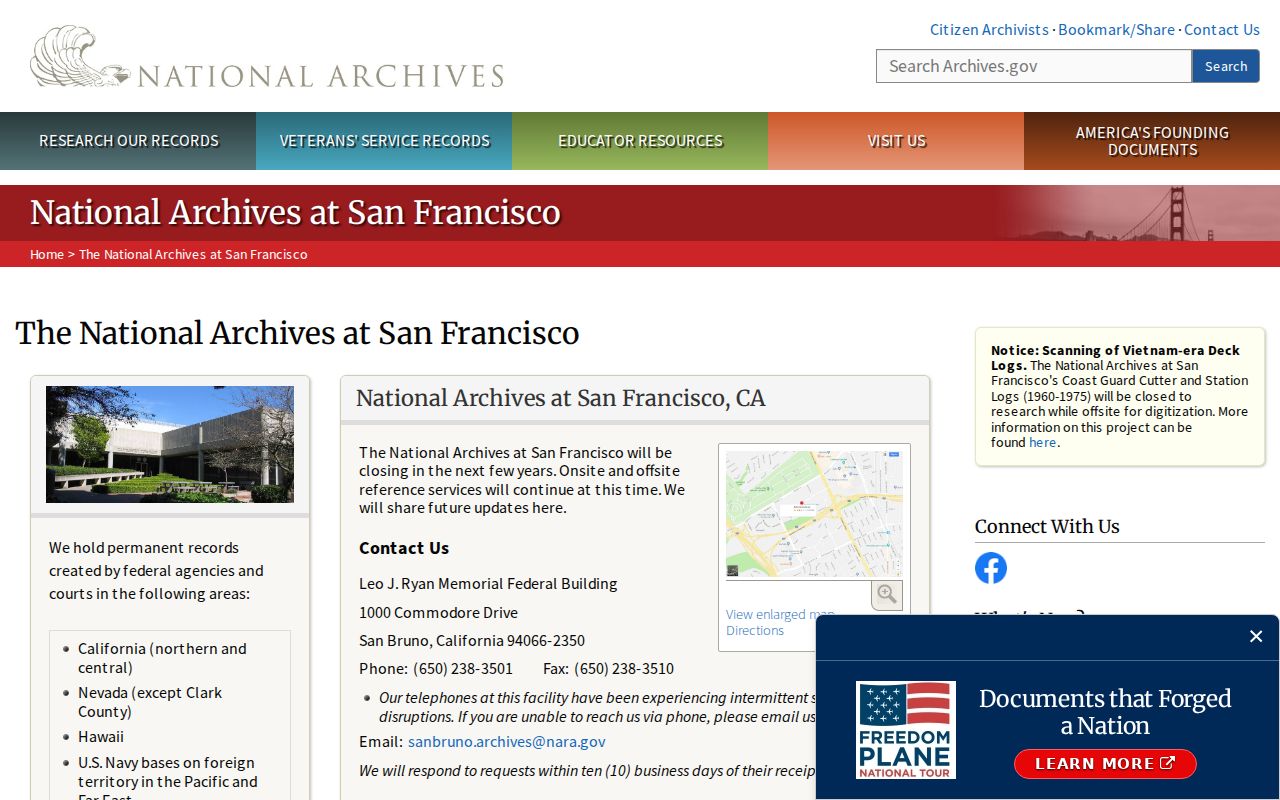
A directory date is a snapshot. A deed, tax list, or census date is a different snapshot. The family trail is strongest when the snapshots agree on more than a surname.
Note: A census and a city directory describe different snapshots, so agreement on name, place, and date matters.
San Rafael Directory Name Index
Flack's Marin Chronology is a local story inside the directory shelf. The WPA-produced work has both subject and name indexes, so it can connect a person to a local event when a standard surname search gives little context. It is not a resident roll. It is a name-rich event index that can send a researcher to a date, newspaper, or archive item.
Newspapers add another bridge. The Marin County Tocsin ran from 1861 to 1918, and the Marin Journal covers an overlapping period. Search surname variants, street names, business names, and probate or legal-notice columns, then inspect the page image because old type and OCR can alter initials.
These sources are especially useful for a former household, a community role, or an obituary lead. They should be read beside the directory entry, not treated as a substitute for an official certificate.
San Rafael Directories and Sanborn Maps
The Library of Congress Sanborn collection provides nine freely viewable San Rafael sheets from May 1887. Known local editions include 1887, 1894, 1924, and 1950. A Sanborn sheet shows building footprints, construction, use, outbuildings, street numbers, fire protection, and water context. It does not name the people who lived in a building.
Use a sheet after a city directory gives a street number. The map can show whether the structure, lot line, or street number matches the address in the book. A deed or tax list can then separate occupant from owner. This approach is helpful for house history and for checking whether an old address description still fits the modern parcel.
For the current parcel and owner chain, return to the deed and APN sources rather than asking a historical map to answer a present-day resident question.
Note: Sanborn maps explain buildings and street numbers; they do not identify the occupants of a San Rafael address.